Author and third-generation innovator
Howard A. Dahl
President and CEO of Amity Technology in Fargo, Dahl tells this family story from inside its triumphs, failures and hardest decisions.
A North Dakota story with global reach
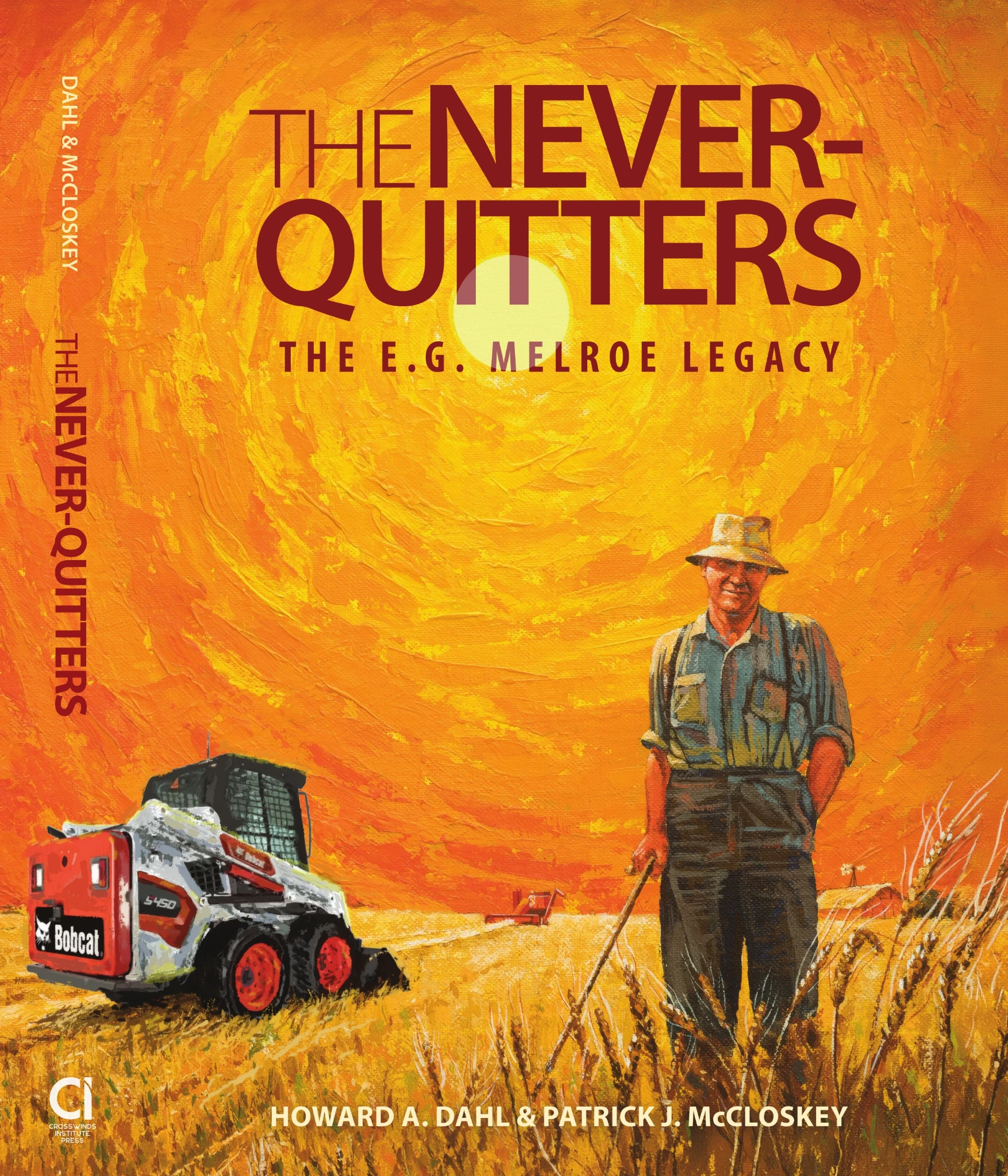
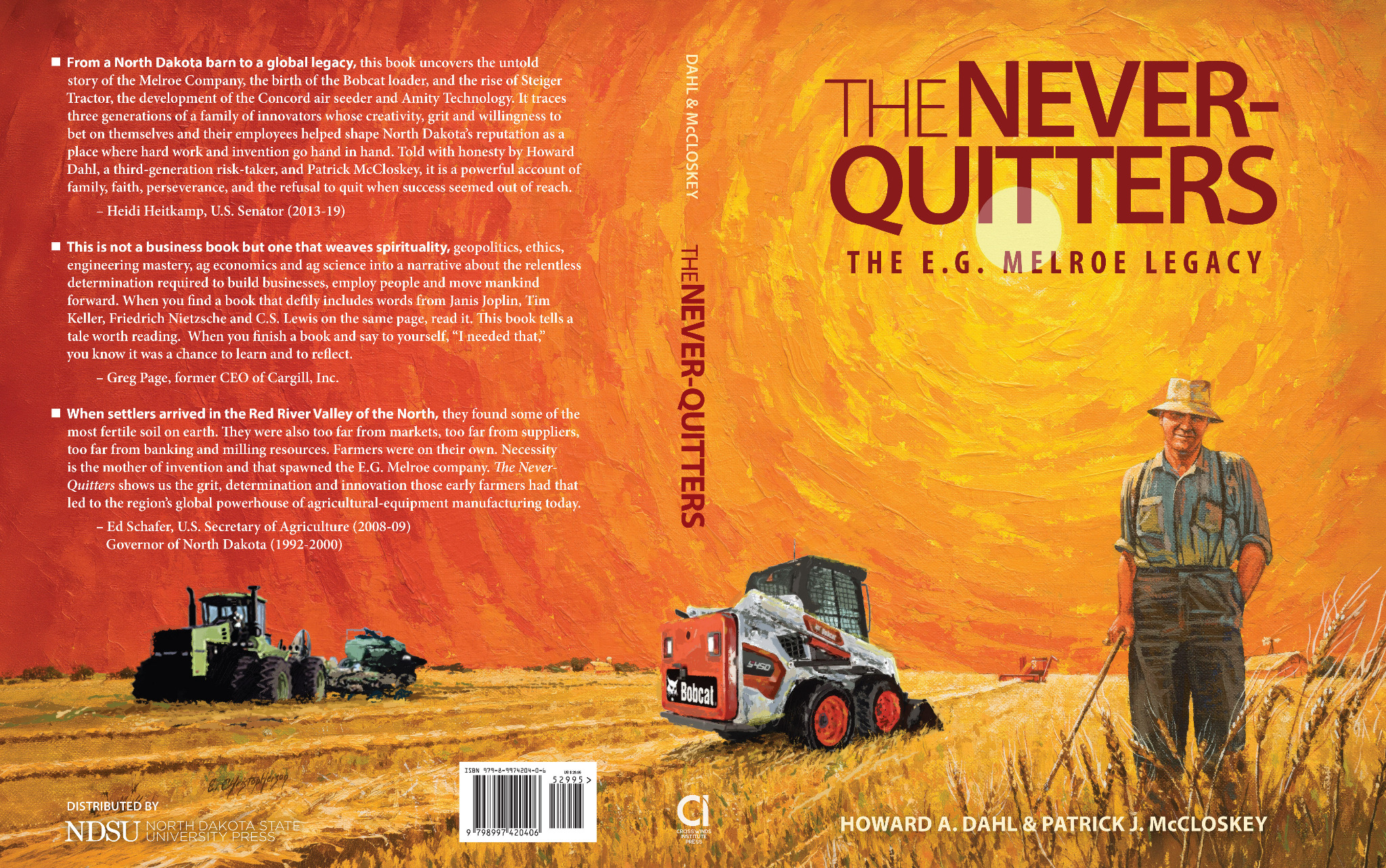
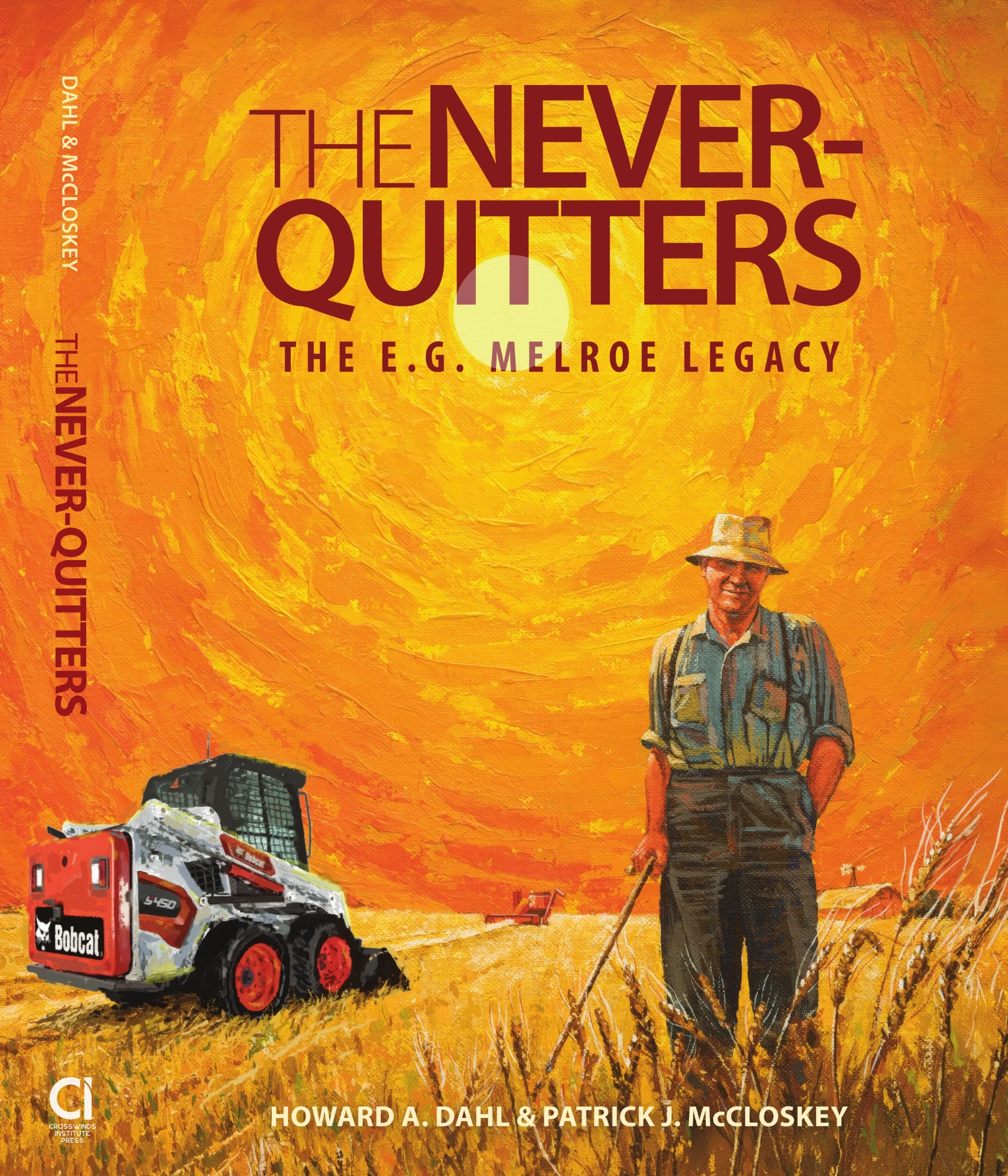
The E.G. Melroe Legacy
The untold story of the family, failures, faith and relentless innovation behind some of agriculture’s most important machines.
Across three generations, one family faced drought, debt, broken machinery and doubt. What they built helped transform American agriculture—and the world.
Innovation.Risk.Faith.Perseverance.
From a North Dakota barn to a global legacy.
— Heidi Heitkamp, former U.S. senatorWith this book, the authors tell a story worth knowing.
— John Hoeven, U.S. senator, former governor of North DakotaWhy this story matters
More than a business story. It’s a never-quit story.
The story begins in 19th-century Norway, where violence and fraud propel a family toward a better life in America. It reaches the North Dakota prairie, where E.G. Melroe’s first invention arrives on the eve of an agricultural depression.
What follows is no smooth march to success. Companies hang by a thread. Credit tightens. Machines break. Family and faith are tested. At each turning point, the Melroe and Dahl families must decide whether to retreat—or bet again on an idea, their employees and one another.
That welder is just as important to this company as I am.
Gene Dahl
His belief about leadership at Steiger TractorWho is telling it
Author and third-generation innovator
President and CEO of Amity Technology in Fargo, Dahl tells this family story from inside its triumphs, failures and hardest decisions.

Author and journalist
McCloskey brings a seasoned reporter’s eye to more than a century of family, business and agricultural history.
The legacy
From Gwinner to the world
Each chapter of innovation begins under pressure—and expands what people thought possible on farms, in factories and across borders.
1920–41
01E.G. Melroe’s first invention, a tractor, is built just before the worst farm depression in U.S. history, which lasted a hard 20 years. E.G.’s never-quitter spirit endures farm loss, heart attack, amputation and forced sale of his first patent.
1941–55
02E.G. recovers lost farmland despite three sons serving in WWII. He then founds the family company to successfully re-invent the windrow-pickup and invent the Melroe Harroweeder.
1955–69
03E.G.’s sons and son-in-law, Gene Dahl, take over the company and battle severe setbacks as they develop the Bobcat loader into North Dakota’s signature product to the world.
1970–86
04Gene Dahl risks everything to save Steiger Tractor and, against steep odds, builds the company into the world’s top manufacturer of powerful 4WD articulated tractors.
1977–96
05Howard and Brian Dahl carry the never-quitter ethos into founding Concord at the worst time for farm-equipment manufacturing since the 1920s. Will the never-quitter spirit prevail?
1996–present
06Howard and Brian Dahl found Amity to continue marketing air seeders and sugar beet harvesters, which they build, domestically and in former Soviet countries despite tough obstacles.
1920–tomorrow
07Dozens of manufacturing, supply, service, dealership and AgTech companies grow from what E.G. began and the next two generations built, precipitating an ag ecosystem now characterized as the Silicon Valley of Ag—the platform for future never-quitters.
Why it matters now
The book connects the Melroe legacy to the Fargo region’s agricultural-technology ecosystem—the manufacturers, dealers, engineers and entrepreneurs who turned prairie necessity into global innovation.
Featured praise
Early readers
When you finish a book and say to yourself, “I needed that,” you know it was a chance to learn and to reflect.
A powerful account of family, faith, perseverance and the refusal to quit when success seemed out of reach.
An engaging and inspiring story that every engineer, entrepreneur and business school educator should have as required reading.
This book reveals a far deeper journey—marked by significant setbacks and remarkable achievements.
The Never-Quitters shows us the grit, determination and innovation those early farmers had that led to the region’s global powerhouse of agricultural-equipment manufacturing today.
The authors have written a business history that is really a meditation on what it means to keep building, to keep the faith and to never quit.
This is a wonderful story for anyone who wants to read an inspiring and unvarnished side of how real businesses get launched and grown.
The authors tell a story worth knowing, one that can inspire future innovators to keep moving forward and persevere through hardship to success.
These were true entrepreneurs who took real risks and succeeded mostly because they followed the theme of this book: Never quit.
Read from the book
A glimpse inside
Read Doug Burgum’s foreword and Howard Dahl’s introduction here without leaving the site—or download either original PDF for later.
Foreword
Growing up in North Dakota, you don’t have to look far to find stories of people who saw possibility where others saw barriers—people who believed that with enough ingenuity, hard work and neighbor-to-neighbor trust, you could build something that changed the world. Long before I led Great Plains Software or stepped into public service, those were the stories that shaped my understanding of what’s possible.
Few families embody that spirit more than the Melroes, the Dahls and the remarkable innovators behind Bobcat and Steiger. Their work didn’t just create machines; it created momentum—economic, cultural and generational. Bobcat grew into a globally recognized brand—one tough animal—synonymous with durability, versatility and the kind of practical innovation that starts on the prairie and ends up reshaping industries around the world. Together, these companies helped define what it means to build in North Dakota: Start with a problem, gather a team of people who care deeply and keep iterating until you’ve built something that works better, lasts longer and helps more people than anyone thought possible.
My journey with Bobcat and Steiger is personal. Growing up working at our family elevator business, I first had the joy of operating a Bobcat loader in high school. We were moving dry pelleted fertilizer in bulk late into the evening after spring track practice. The speed, power and productivity increase versus hard shoveling was incredible. The agility and precision of movement in tight warehouses was exhilarating. The Steiger plant tour was a highlight for many in the business and industrial engineering classes in college at NDSU. Like most small-town North Dakotans, “class B” kids, this was the first, large-scale manufacturing plant I had ever experienced. It was eye-opening and mind-expanding.
Later, as my career in building software companies took me around the country and world, I would beam with North Dakota pride seeing and taking pictures of Bobcats from Manhattan to Moscow and nearly every place in between.
After Great Plains went public, I was asked the classic question by a Wall Street analyst if I was going to buy a sports car. I replied, “No, but I am going to buy a Bobcat!” Thus began my 30 years and counting as a Bobcat customer.
Later in life, North Dakota’s now former First Lady Kathryn Helgaas Burgum worked for Bobcat as one of the initial market managers for the launch of the innovative side-by-side Bobcat, the Toolcat. Last year while in my current role, I sprinted across the South Lawn to get my picture taken with one of our great National Park team members who was working with a Toolcat at the White House.
Howard Dahl coauthors this book not as an observer, but as a son, a steward and a fellow entrepreneur who has spent his life carrying forward the same values that animated his father and uncles. And he tells it alongside the stories of others whose leadership and grit shaped this era—entrepreneurs and innovators, like Ron Offutt, Barry Batcheller, Ron Bergan and others whose names appear throughout these pages. Their collective contributions remind us that progress is never the work of one person or one family. It is the product of teams, mentors, risk-takers, early believers, families and communities that rally around an idea and refuse to let it fade.
This book captures that history with clarity, honesty and heart. It reminds us that world-changing ideas don’t require perfect conditions. They require courage; they require persistence. And they require leaders who are willing to take risks, overcome their self-doubt, stand strong in the face of their critics, learn from failure and keep moving forward.
The skid-steer loader and four-wheel-drive tractor revolutionized agriculture and construction, but their deeper legacy is the mindset they represent: The best solutions often come from people who are closest to the work, who listen deeply and who never stop tinkering. That curiosity-driven mindset continues to shape North Dakota today—from our farms and factories to our startups and research labs.
Howard’s telling of this history is a gift. It preserves the lessons of a generation of builders whose impact continues to ripple across the country and around the world. And it offers inspiration for the next generation of innovators—those who will write the next chapter of American ingenuity from rural places that many still discount and underestimate.
As someone who has spent his life at the intersection of innovation, entrepreneurship and public service, I am grateful for this book and for the legacy it honors. The story of Melroe, Bobcat and Steiger and others is a reminder of what can happen when people believe in possibility, invest in one another and commit to building things that matter. It reflects the very best of America—our capacity to dream boldly, work tirelessly and never quit on an idea worth pursuing.
I invite you to read these pages with curiosity and pride. They tell a story that belongs not only to one family or one company, but to everyone who believes in the power of ideas—and in the extraordinary potential of the people of North Dakota to inspire our nation and the world.
Disclaimer: Mr. Burgum, a lifelong North Dakotan, has served as an entrepreneur, governor of the state of North Dakota and the 55th secretary of the U.S. Department of the Interior. The views expressed here are his own and do not represent the views of the department or the U.S. government.
Introduction
I was having lunch with my father, brother and two of my mother’s brothers, Cliff and Irv Melroe, in early 2000 when one of them said, “The story of the Bobcat loader has never been told properly.” That thought lingered in my mind for years and became a recurring call to action.
What finally triggered the decision to proceed with this book was the realization that there was also an important story that needed to be told about the roots of agricultural innovation in our region. This story leads to and includes the history of the Bobcat loader and also the history of the Steiger tractor. Steiger is the other prominent name that invariably emerges when anyone talks or writes about the immense amount of agricultural innovation in the Fargo area that has taken place over the last century—and is now accelerating.
While most people today readily recognize the names “Bobcat” and “Steiger,” far fewer know the name “Melroe.” It was the company that first manufactured the Bobcat loader, and the Melroe name was borne by the hundreds of thousands of Bobcat loaders produced from 1961 to 2000 when Ingersoll Rand, which acquired the brand five years earlier, removed “Melroe” from the loaders and changed the company’s name to the Bobcat Company.
Although the Melroe name has faded from memory, E.G. Melroe’s inventions and the company he founded have had a profound and lasting impact on our region. E.G. was my maternal grandfather. In 1947, he established the Melroe Manufacturing Company, which later dropped “Manufacturing” from its moniker. After E.G.’s untimely passing in 1955, his four sons (Les, Cliff, Irv and Roger), along with his son-in-law (Eugene “Gene” Dahl, my father), took over and grew the company. The Melroe Company’s Bobcat loader is North Dakota’s signature to the world in that there are Bobcat loaders found in every country around the globe.
After the Melroe family sold the company in 1969, my Uncle Les Melroe acquired majority control of the Steiger Tractor Company. The following year, my father made a major investment and came on board to run the company as it pioneered the high-powered, four-wheel-drive (4WD) tractor industry.
At TEDx Fargo in 2018, Barry Batcheller—my father’s favorite engineer at Steiger and my long-term friend—spoke “about a region in this nation that is developing technologies that are so profound that their implementation will change the course of humankind. Now you may think that I’m talking about Silicon Valley, but I’m not.” Instead, Barry referred to the Fargo region, which he said had developed so many similarities that it might become the Silicon Valley of agricultural technology.
Six years later, Barry spoke at an “Ag Innovation Corridor” event at North Dakota State University (NDSU) in which he drew a straight line from the Bobcat loader (the Melroe Company) through Steiger Tractor and the companies Barry founded in Fargo (Phoenix International and Appareo Systems, LLC, which were acquired by Deere and AGCO, respectively) to Grand Farm, asserting that “we are doing the exact same things as the founders of Silicon Valley, although we just don’t notice it.”
Barry could only have proposed such a seemingly outrageous claim because of the legacy initiated by E.G. Melroe. This legacy must be understood to comprehend what’s happening in the Fargo area today.
As chronicled in Chapter Twenty-Six, dozens of companies were founded here to service the building of Bobcat loaders and Steiger tractors, and many more companies were founded and prospered as the ag-equipment and research-and-development (R&D) ecosystem grew in the Fargo region. Major equipment manufacturers acquired both companies and continue to operate in the area. The Bobcat Company is currently owned by the Doosan Corporation, and Steiger Tractor was acquired by CNH Global N.V., one of the world’s largest farm machinery manufacturers. The other two top equipment builders, Deere and AGCO, also have a strong manufacturing presence here.
Fargo is home to the world’s largest Deere dealer, RDO Equipment Co., and another of Deere’s largest dealers, Brandt Holdings. Fargo is also home to the largest retailer of CNH equipment, Titan Machinery. The second largest AGCO retailer, Butler Machinery, is headquartered in Fargo. In addition to manufacturing and retailing, many other companies have emerged to create a robust infrastructure for agricultural innovation.
What started in E.G.’s barn in Gwinner, North Dakota (about 86 miles southwest of Fargo), evolved into a family tree of invention and manufacturing that eventually blossomed into the vibrant innovation forest flourishing in the Fargo area today.
If E.G. Melroe had never been born, would this plethora of agricultural development and growth have occurred? Yes, of course, but not likely here. Fargo was not a natural powerhouse of agrarian invention, innovation and manufacturing. Although the region’s rich soil made the Red River Valley a highly productive farming area, there was no dependable, navigable waterway, nor was there any major urban center in the region.
However, the story of E.G.’s inventions and the company he founded is anything but an easy, smooth tale of success. Many times, all seemed lost—but for indomitable perseverance. This story of never-quitters repeated throughout E.G.’s endeavors, throughout my father’s involvement in Steiger Tractor and throughout the struggles my brother, Brian, and I endured establishing Concord, Inc. Without the never-quitter ethos, none of these companies had a prayer of succeeding.
Please note that the stories of the Melroe Company and Steiger Tractor are not intended to be comprehensive histories but, instead, chronicles and reflections based on the personal experiences of my father, my brother, me and several key individuals who were interviewed at length. I apologize for leaving out so many people who helped make the companies so successful.
For additional details, please consult books by Lee Klancher, Peter D. Simpson, Martin Padgett and others.
When I began working on this book, I had no intention of referencing my private journals. However, I believe some entries from Concord’s critical period—October 1987 to the end of 1989—shed considerable light on both my personal struggles with Concord’s seemingly impossible challenges and the challenges every executive faces in running a business according to Christian principles.
This generational story, dedicated to those who never quit, I feel compelled to tell.
Order now
The Never-Quitters: The E.G. Melroe Legacy
Howard A.
Dahl and Patrick J. McCloskey
Choose your country to continue to secure checkout.
Stay with the story
Be among the first to know when ordering opens, an excerpt is released, or an author appearance is scheduled.
Email us to request book news and announcements. You can copy the address, open Gmail, or use your device’s default email app.
Media & events
For journalists, hosts and event organizers
Upcoming appearances
Labor Day weekend at the Steiger Heritage Club exhibition in Rollag, Minnesota.
Books for sale and book signingVisit Amity Technology at Booth 510 at the Red River Valley Fairgrounds in West Fargo.
Books for sale and book signingPresented by Emerging Prairie at the Grand Farm Innovation Campus near Wheatland, North Dakota.
Books for sale and book signing